
Watches and Wonders 2026: Rolex – this year's news and big changes
Rolex does not go broad, they go precise. At Watches and Wonders 2026 it is all about refinement, anniversaries and small but strategic changes. But behind the controlled surface hides one of the more interesting updates in a long time.


Rolex does not go broad, they go precise. During Watches and Wonders 2026 everything is about refinement, anniversaries and small but strategic changes. But behind the controlled surface hides one of the more interesting updates in a long time.

100 years of the Oyster – a shift of identity
That the Oyster case turns 100 years old is not just a milestone, it is an opportunity for Rolex to reposition one of its most fundamental models. The Oyster Perpetual has long been the entry model, the clean, stripped-back Rolex with no complications or excess.
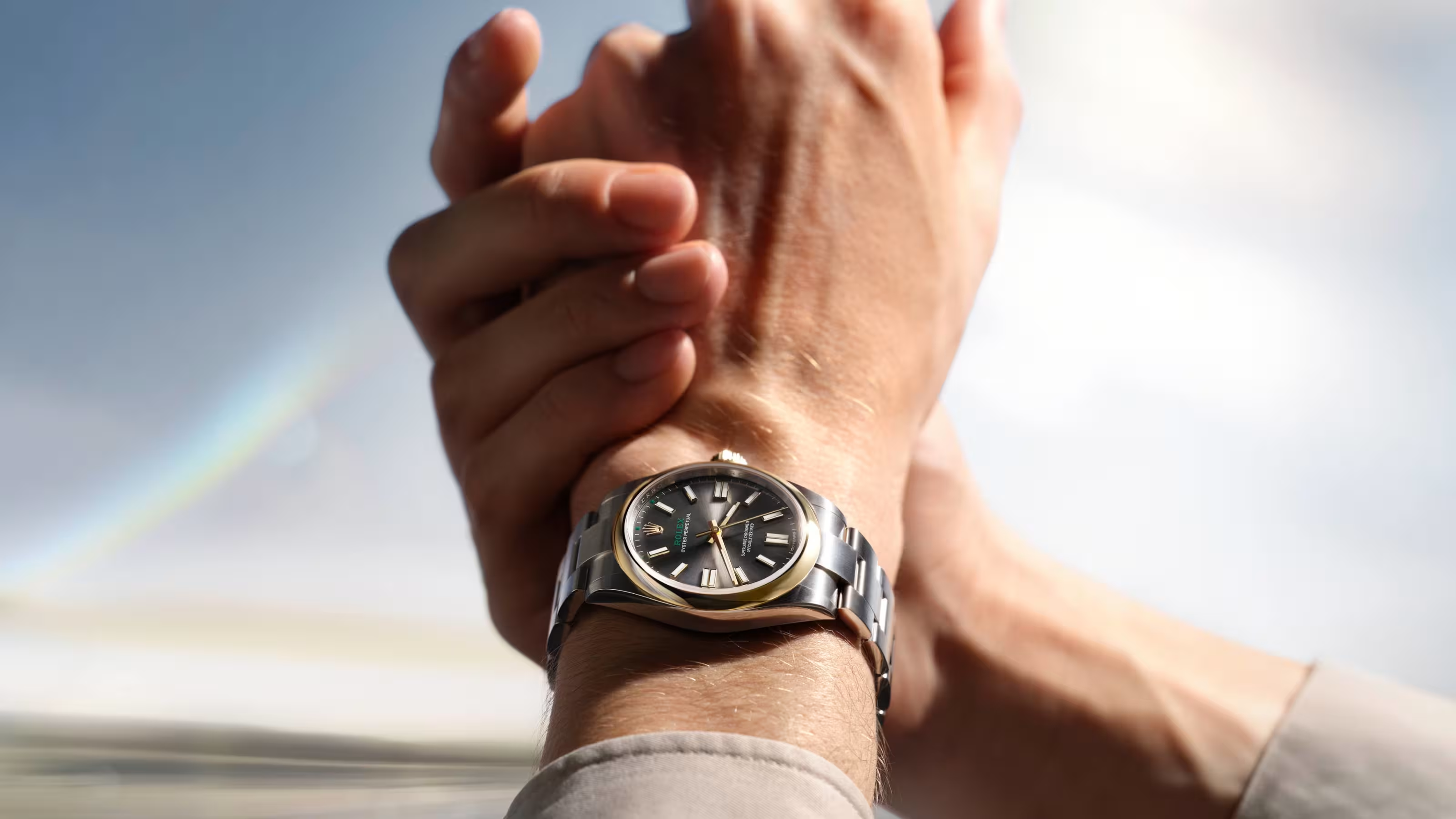
With the introduction of Rolesor in the OP family, something interesting happens. The combination of steel and gold has traditionally been reserved for the Datejust and more dressed-up models. Now that this moves into the Oyster Perpetual, the line between entry level and luxury is blurred.
The 41 millimetre model becomes central here. The dial is restrained but with clear anniversary markers. It is not about looking backwards, but about showing that even the most fundamental models can carry the history forward. It is a way of giving the Oyster Perpetual more weight, both symbolically and commercially.
Oyster Perpetual 36 – Rolex dares again
At the same time Rolex continues to explore more expressive dials. The Oyster Perpetual 36 with the new Jubilee dial is a clear example. Here a repetitive pattern is used where the brand itself becomes design.
At first glance it can feel playful, but it is also a controlled step in a direction where Rolex allows itself to be more visual. After earlier successes with colourful OP models, this shows that the demand is there and that Rolex is prepared to meet it, but on their own terms.
This is also a model that will probably be hard to get hold of. The combination of classic size, clear identity and limited availability usually leads to exactly that.

Day-Date 40 – new material as strategy
At the highest level it is the material that drives the development. The Day-Date 40 in Jubilee Gold is a clear example of this. Rolex continues to develop its own alloys, not just for technical performance but to create a unique visual identity.
Jubilee Gold moves between different shades depending on light and surroundings. That gives the watch a more lively expression than traditional gold colours. Together with exclusive dials, such as aventurine, the feeling is reinforced that this is something more than a classic Day-Date.
This is Rolex in its most consistent form. No drastic design changes, but a clear refinement where every detail is considered.

Oyster Perpetual 28, 31 and 34 mm – small formats, big shift
Rolex makes a clear shift in position this year by lifting both the Oyster Perpetual 28 and 34 out of their classic entry segment. Both models are presented in solid gold and are more about material and expression than about technology. The 28 mm comes in yellow gold with a green stone lacquer dial, while the 34 mm gets Everose gold in combination with a blue variant. It is not only the colour choices that are new, but how Rolex works with surfaces and texture. For the first time in the Oyster Perpetual, natural stone indices are used at 3, 6 and 9, which gives the dials a more tactile and lively expression.
The finish is at least as important. Case and bracelet are mainly satin-brushed, something that breaks with Rolex's traditional use of highly polished gold. The result is considerably more toned down and modern, almost tool-like despite the whole watch being in precious metal.
The sizes also matter here. The 28 mm feels more jewellery-oriented and warm in its expression, while the 34 mm lands in a more balanced, classic format that can be worn more widely. Both are driven by calibre 2232, but it is clear that Rolex is not trying to impress technically in this case.
This is instead a signal of something bigger. The Oyster Perpetual is in the process of changing. From being the cleanest and most stripped-back Rolex model to becoming a platform where material, finish and feel are given more space.


Yacht-Master II – function meets ease of use
The Yacht-Master II has always been one of Rolex's most technical models, but also one of the most difficult to use. With this year's update Rolex tries to change that. The countdown function has been made more intuitive and easier to use. The programming is simpler and the legibility improved. That makes the model more accessible, without compromising its functional core.
This is an important signal. Rolex shows that even their most complex models have to be adapted to how they are actually used. The model is released in steel and solid gold.


Datejust – evolution in its purest form
The Datejust is perhaps the model that most clearly shows how Rolex works over time. For 2026 it is about new dials rather than new constructions.
The green ombré dial stands out. It creates depth and variation without breaking with the model's fundamental DNA. It is exactly the type of change that keeps the Datejust relevant, year after year. It is not about surprising, but about refining. And that is precisely where Rolex is at its strongest. Rolex releases a range of new models in different sizes.


Cosmograph Daytona – Rolesium in a new interpretation
Rolex continues to develop the Daytona in small but clear steps and this year's news is a good example of that. The new Cosmograph Daytona is presented in a Rolesium configuration where Oystersteel is combined with platinum, which gives the model a more technical and subtle luxury than the more classic solid gold versions.
The most eye-catching thing is the dial in white enamel. It gives a deep, almost porcelain-like feel that stands in clear contrast to the anthracite-coloured Cerachrom bezel. The bezel, made in a tungsten-rich ceramic composition, has a more metallic character than before and is framed by a thin platinum ring that reinforces the overall impression.
The details in the tachymeter scale are also worth highlighting. The numerals are presented horizontally, a clear reference to the first Cosmograph Daytona models, but here in a modernised, more contemporary typeface. The effect is a blend of historical continuity and present-day precision.
Another important update is that the movement is now exposed through a sapphire crystal caseback, fixed with a ring in platinum. That gives a new dimension to the Daytona, which has traditionally been more closed, and reinforces the feeling that this is not just a tool but also an object for appreciation at the detail level.
The whole is typically Rolex. No dramatic changes, but a carefully weighed combination of material, history and technology that takes the Daytona further without breaking with its identity.

Watches and Wonders 2026: Rolex – this year's news and big changes
The perhaps most talked-about change, however, is that the GMT-Master II with red and blue bezel disappears.
It is not just a model being removed. It is a symbol. The Pepsi has been one of the most sought-after modern Rolex models and its absence leaves a clear void in the collection. What it means in the long term is unclear. It could be about production, strategy or a preparation for something new. Whichever it is, it directly affects the secondary market and how collectors view the model going forward.


