
The new Omega Railmaster
Omega's somewhat odd bird the Railmaster dates back to 1957 and has for a good two decades been based on the Seamaster Aqua Terra. Just recently the company presented a new version that takes the instrument watch, as discreet as it is legible, to new heights. Eqotime naturally wants to show it off and serves up a little history at the same time.

Omega's somewhat odd bird the Railmaster has ancestry from 1957 and has for a good two decades been based on the Seamaster Aqua Terra. Quite recently the company presented a new version that takes the as discreet as refreshing instrument watch to new heights. Eqotime of course wants to show it off and at the same time offers a bit of history.
Text: Filip Ericsson
The Omega Railmaster was launched for the first time in 1957 as part of the trilogy of watches that was named the “Professional Line”. It was thereby shown at the same time as two other instrument watches, the today so famous Speedmaster and Seamaster 300.
Where the Speedmaster was intended for racing drivers (but which then got to fly all the way to the moon) and the Seamaster 300 for professional divers, the Railmaster was meant to serve with scientists and railway employees.
The Railmaster was on the outside in principle a Seamaster 300 that had lost its rotating bezel, and thereby shared its design language with the brand's earlier field and military watches. What stood out with the Railmaster was the protection against magnetic fields for the movement of up to 1000 Gauss – just as much as its foremost competitors, the IWC Ingenieur and the Rolex Milgauss. This was to guarantee the watch's precision for those professionals whose work came into contact with environments where these magnetic fields occurred.

Unlike the today so legendary Seamaster and Speedmaster watches the success failed to materialise for the Railmaster, whereupon it disappeared from the range some time during the 1960s. The return took all the way until 2003 when the Railmaster had been transformed into a variant of the Seamaster Aqua Terra which had come out the year before.
In 2017 the Railmaster shed its skin again and was endowed with more of its own identity, as well as a modern Master Chronometer movement – for the first time in the model series. This Railmaster stood out through its fully brushed case and bracelet, a curiosity considering that the vast majority of steel watches at least have some polished surfaces.
The same year an anniversary model also came out to celebrate the Professional Line series which turned 60 that year. A set with three retro shaped variants of the Seamaster, Speedmaster and Railmaster was sold in a limited edition. They could however also be bought separately in an unlimited edition, and this Railmaster is still on the price list in Omega's online shop.


The new Railmaster
The Railmaster is now once again approaching the Aqua Terra in its design language and thereby resembles the generation that came out in 2003. The official name is also “Seamaster Railmaster”, a slightly awkward model name one might think. For the sake of simplicity we therefore today say “Railmaster” plain and simple.
The dimensions are restrained with a case that measures 38mm in diameter, unlike the outgoing series which measured 40mm. Probably a 41mm variant will however turn up eventually since the Aqua Terra is after all sold with 38 as well as 41mm cases, but that is so far speculation.
The thickness stops at 12.4mm and it is gratifying to see that Omega has put the brakes on the development towards ever thicker cases. The Seamaster models have after all swelled a little too much in height in recent years if the undersigned may say so himself. Just as for the Aqua Terra the Railmaster is incidentally tight down to the equivalent of 150 metres and thus withstands all the water activities you can imagine on the holiday trip. Good!

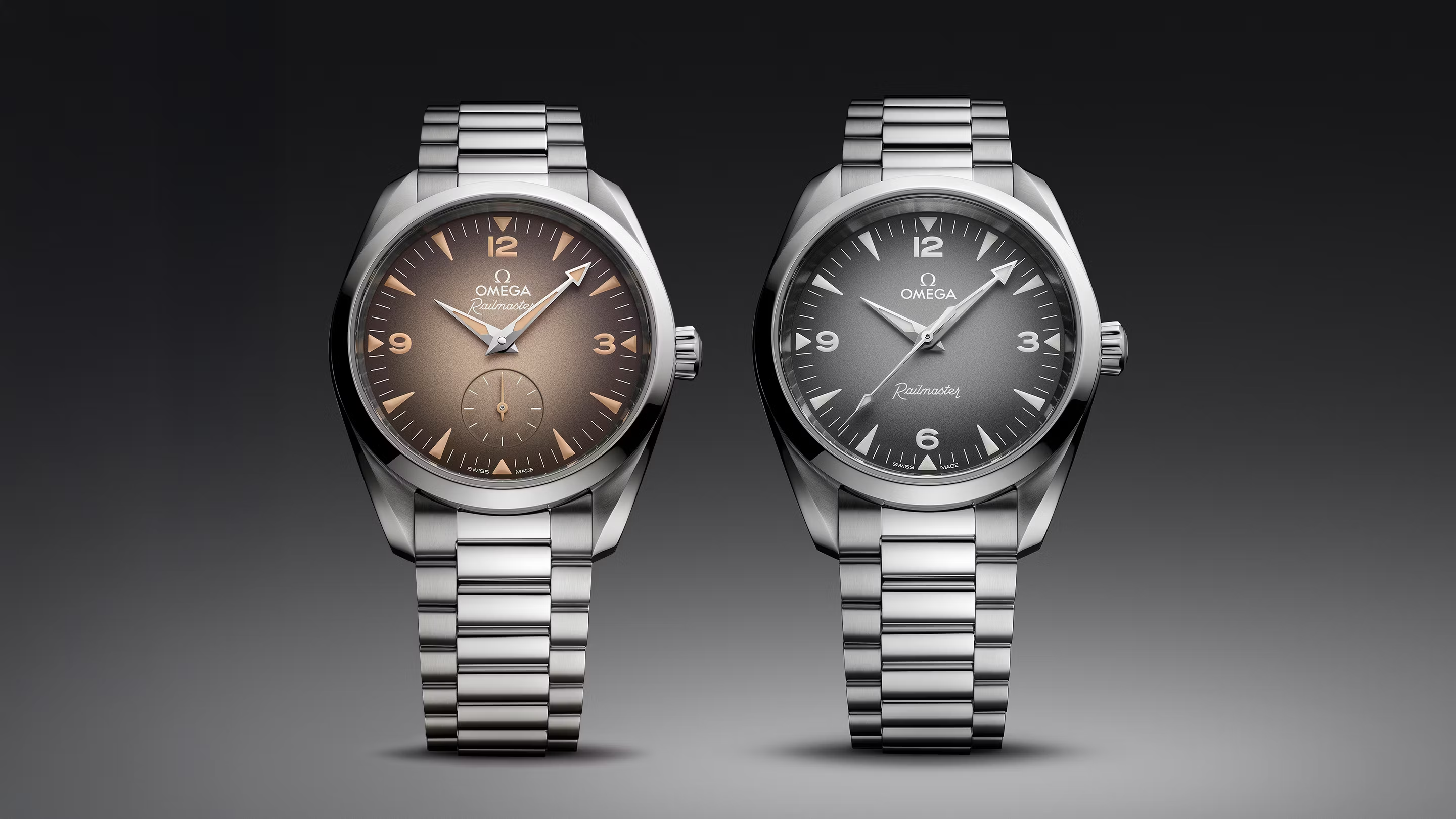
The new Railmaster is offered to begin with with two different dials, a grey one and a beige brown one. Both have a so-called “gradient dial” which means a dial with a shifting shade, lightest in the middle and gradually darker out towards the edge.
Interesting is that the brown beige variant has a small seconds hand at 6 o'clock while the grey one has been endowed with a traditional centre placed hand.
The dials otherwise have a classic Railmaster theme, with the triangular indicators, Arabic numerals at 3-6-9-12, the “broad arrow” hands mirroring the 1957 model as well as no date – all of them are attributes that separate the Railmaster from its Aqua Terra sibling and give the former a more puristic, professional character.
The case is otherwise the same, with its discreet, classic and well turned lines. The difference is however that the Railmaster has both polished and brushed surfaces, while the Aqua Terra is glossier with its exclusively polished surfaces. The undersigned definitely prefers the Railmaster's execution which gives a more toned down elegant expression, over the Aqua Terra's slightly showier ditto. But that is of course a matter of taste.

Movement
Inside sits of course Omega's own developed, state of the art movement of Co-Axial construction which has been certified to the Master Chronometer standard. Caliber 8804 drives the brown version with the small seconds hand and Caliber 8806 the grey one with the large hand.
The Master Chronometer certification was introduced in 2015 and means that the movement is not only tested by COSC (Official Swiss Chronometer Testing Institute), but also by METAS (The Federal institute of Metrology), which secures an even higher degree of precision.
Every Master Chronometer watch goes through eight different tests where precision, protection against magnetic fields, power reserve as well as water resistance are examined. The certification means that the watches must manage 0/+5, 0/+6 or or 0/+7 seconds per day (depending on the calibre), while the requirement for an “ordinary” chronometer watch is -4/+6 seconds.
In addition – extra important for the Railmaster in particular – is that the movements are protected against magnetic fields up to 15 000 Gauss, thus fifteen times higher than the first Railmaster watch from 1957.
The back is in glass which is why you can also enjoy the fine Omega movement with your own eyes. On the other hand it can at the same time come across as a little pubescent in a serious instrument watch like the Omega Railmaster. A solemn metallurgy doctor in a white coat with responsibility for a country's railway network would perhaps prefer a stricter case back in steel!
The new Railmaster is offered with the same good looking steel bracelet as the Aqua Terra or alternatively a leather strap, light brown for the brown variant and black for the grey one. The prices are of course high but actually significantly lower than for the Aqua Terra. Price list in Omega's web shop for the four variants as below:
67 800 kr (grey, leather strap)
72 300 kr (grey, steel bracelet)
75 300 kr (brown, leather strap)
79 800 kr (brown, steel bracelet)

Railroad watch
The extremely narrow but time-honoured segment “Railroad watch”, järnvägsklocka in plain Swedish, should be seen as a subcategory to the better known genre “instrument watch”. Such a one can be defined as a working instrument for practitioners of professional occupations, such as astronauts, pilots, divers, engineers, and so on.
At least it was like that in the past before various electronic instruments replaced the mechanical wristwatches. Today most instrument watches are probably more symbols and historical reminders for amateur wearers, than indispensable instruments as such.
The market for instrument watches is as is known divided into different sub-segments that are governed by themes based on area of use, such as the diver's watch, the pilot's watch, the racing chronograph and so on.
The railway watch is a segment that is often forgotten but which should hardly be belittled! It refers to wristwatches that originally functioned as vitally important working instruments for train conductors. They have their origin in the North American railway system at the end of the 1800s and consisted from the beginning exclusively of pocket watches. Wristwatches did after all break through a decade or so later.

The segment was born with the severe safety deficiencies that characterised the then new railways which were uncovered with serious train collisions with catastrophic consequences. One cause was that the conductors could not measure the time correctly.
The railway industry thereby joined together with the American watch industry to create watches that were sufficiently exact, reliable and easy to read to maintain safety on the rails. The American Ball and Hamilton were involved from the beginning and also Swiss manufacturers such as Longines, Girard-Perregaux and Zenith (among others) would later come to deliver watches to the North American train personnel.
Even if the railway watch today has played out its role as an instrument for railway employees, the Omega Railmaster undeniably fulfils the original requirements with plenty to spare. Discreet, exact, reliable, easy to read and protected against magnetic fields it will surely carry out it its duty without complaint!


